Riga, Latvia

I apparently didn't do much research on Riga before arriving -- I was very pleasantly surprised by all of the fantastic Art Nouveau buildings (there are more than 800 of them in the city!). My hotel was in a good location -- just outside of the old part of town -- and although my room/bed was very comfortable -- it's not a place that I would really recommend (I thought the service was appalling).
I do wish I had seen a performance at the Latvian National Opera and Ballet (birthplace of stars like dancer Mikhail Baryshnikov and diva Elīna Garanča).
Latvia's history is one of repeated occupation for 800 years. Its central position in European trade routes made it a highly-contested region from the 11th century on. The country was controlled by Germany from the 13th to the 16th centuries, then by Poland for the 16th century, and then by Sweden from the early 17th century to the early 18th. The country became part of Russia in 1721.
In 1918, Latvia declared itself an independent state for the first time. This period of Latvian independence was marked by instability -- it was immediately followed by a civil war lasting for two years, and then two more decades of political turmoil.
In 1939, the country came under Soviet control, and the next year was occupied by Nazi Germany for the duration of WWII. Following the war, the country again came under Soviet control. In the late 1980s, dissidents start campaigning for Baltic independence, climaxing in an extraordinary human chain across the Baltics on Aug 23, 1989. The collapse of the Soviet Union the following year freed Latvia to declare independence in 1991.
Interesting tidbits about Riga / Latvia:
- Nearly 1 in 3 of Latvia's two million residents lives in Riga.
- Latvian women are the tallest (on average) on the planet.
- Riga is sometimes described as the Paris of the North.
- An estimated 12.5% of Latvia's population were killed during WWII, third highest behind Poland and Lithuania. As many as 190,000 were subsequently imprisoned in Soviet gulags between 1945 and 1952.
- Latvia's current flag design has been in use since 1280. Only Denmark's has been around longer.
- The most popular sport is ice hockey. Basketball is the big summer sport.
- You'll notice that the oldest churches in the Old Town have roosters atop their spires, not crosses. According to tradition, the rooster scares away the devil and keeps watch for God.
Landmarks viewed/visited:
- Alberta iela - a street almost entirely created by Art Nouveau genius Mikhail Eisenstein, and his son, film director Sergei Eisenstein, was one of the founders of modern cinema.
- Riga experienced its golden age in the early 20th century just as Art Nouveau architecture was coming into fashion, and so the city has one of the world's richest collections of this exuberant style.
- Black Cat House - getting into the Great Guild in Latvia in the 14th century was an incredibly huge honor. Similarly, getting snubbed was a gigantic insult. One Riga local was so offended that he attached two black cats on top of his building so that they would cast their evil glare upon the Guild.
- Bremen Town Musicians - created by Bremen artist Krista Baumgärtel. The sculpture is based on a fairy tale by the Brothers Grimm, but created with political subtext as it was inspired by Mikhail Gorbachev's perestroika. The sculpture, a gift from Riga's sister city Bremen, was made in 1990. The bronze figures are not starting through the window at the robbers' feast; they are peering through the Iron Curtain at a completely new world.
- Freedom Monument - affectionately known as 'Milda', the monument was unveiled in 1935 and is a national shrine for Latvians. The friezes around the base depict Latvians singing, working, and fighting for their freedom, while the three stars in the maiden's hands represent the three historical regions of the country. Locals are always placing flowers at the base of the monument, an act for which people were deported to Siberia in Soviet times.
- House of the Blackheads - if you were a German merchant and single in the Middle Ages, you would have a room here. The house was built in 1334, bombed in 1941, demolished in 1948, reconstructed in 1999.
- Nativity of Christ Cathedral - built in 1883, it's the biggest Orthodox church in the city. Having served as a planetarium and a restaurant during the Soviet regime, the building has been completely restored as a church (I didn't go inside -- strict dress code -- women have to cover their heads).
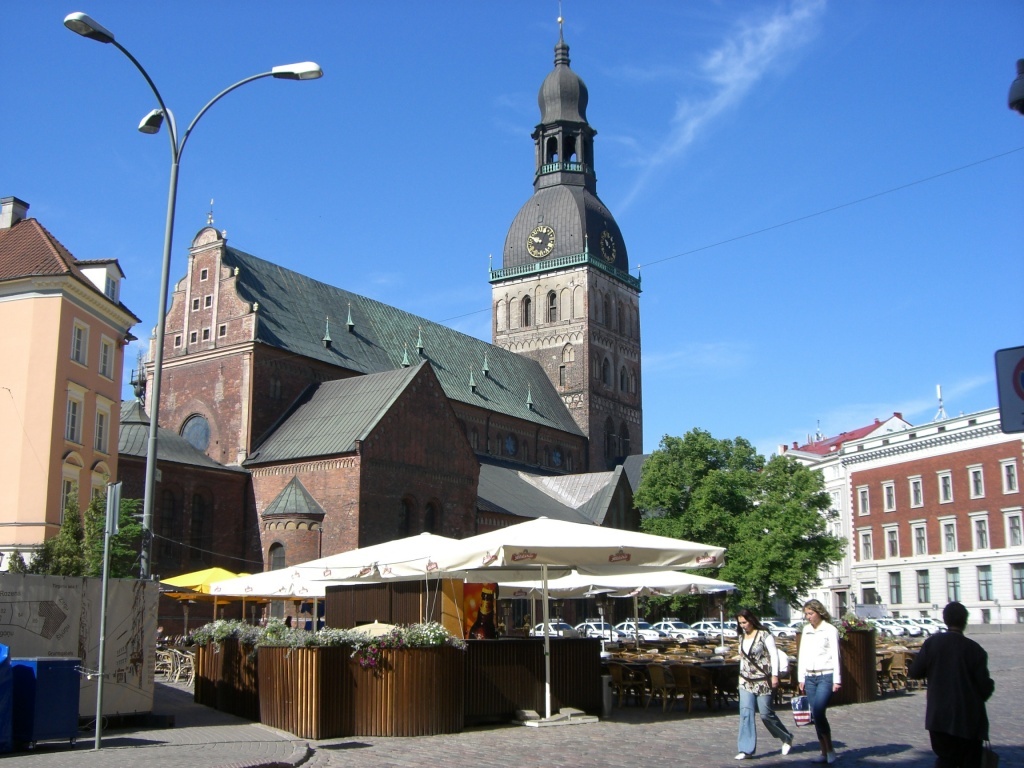
- Riga Cathedral (Lutheran) - built in 1211; religious services were prohibited during the Soviet occupation from 1939 to 1989, and the cathedral was used as a concert hall.
- The church organ is considered one of the most historical organs in the world.
- St James' Cathedral (Roman Catholic) - the beginning of the Reformation in Latvia took place here and in St Peter's Church in 1522.
- St John's Church (Lutheran) - this is the oldest house of worship in Riga.
- St Peter's Church (Lutheran) - built in 1209 and severely damaged in WWII (reconstruction took place over 15 years from 1967 - 1983). It has a cool observation tower -- well worth the 9 euros!
- Three Brothers - almost impossible to photograph! Together, the houses form the oldest complex of homes in Riga. The white house is from the 15th century, the yellow is from the 16th, and the green is from the 17th.


Comments
Post a Comment